Seasonal Constraints & Menu Architecture

Cook with the Growing Year

When diners hear "seasonal menu," they often picture sun-ripened heirloom tomatoes in August or sweet English peas in late May. Yet for working farmers and the chefs who buy directly from them, the growing year is defined as much by scarcity, frost dates, soil moisture, and root-cellar humidity as by peak summer abundance. A restaurant that claims to cook seasonally while serving fresh basil, zucchini, and strawberries twelve months a year is actually cooking according to global air-freight schedules rather than regional agronomy.

Understanding how biological constraints govern the kitchen allows both operators and guests to spot the difference between cosmetic seasonal garnishes and structural menu planning. Below, we examine how micro-seasons, storage crops, rotational legumes, and larder preservation turn agricultural limits into culinary coherence.

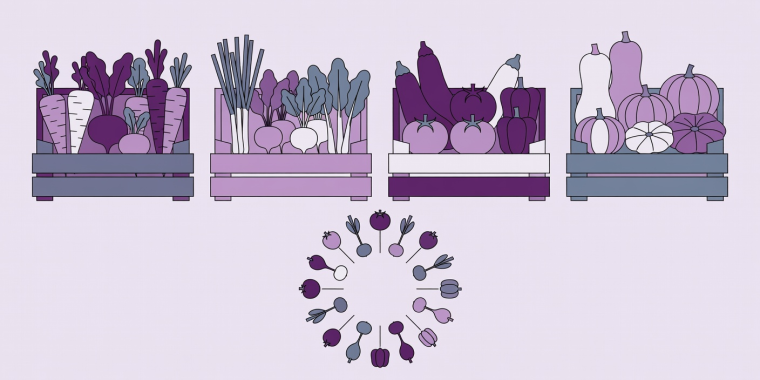
Flat vector illustration in plum, lilac, slate and white depicting four seasonal harvest crates with overwintered roots, spring shoots, summer fruiting crops, and cured autumn squashes
Evidence Category: Phenology

Why calendar dates fail and degree-days matter

Plants do not read wall calendars; they respond to accumulated solar radiation (growing degree-days), soil temperature, and day length (photoperiod). When a cold, wet April delays soil warming by three weeks, local asparagus and strawberries will not arrive simply because a restaurant scheduled its "Spring Menu Launch" for May 1st.

Kitchens genuinely tethered to regional fields write modular menu descriptions. Instead of printing "Sugar Snap Peas with Mint," they print "Early Podded Legumes & Garden Herbs," allowing the line to start with overwintered fava greens, transition into snow peas, and finish with shelling peas as each planting matures.

Menu Claim: "Our spring menu launches March 21st featuring local tender greens."

Question to Investigate: Were these greens grown in unheated high tunnels using cold-hardy varieties like claytonia and mache, or shipped from a distant warm-winter valley?

Evidence Category: The Hunger Gap

Navigating late winter and early spring honestly

In temperate latitudes, the most challenging period for seasonal cooking falls between late February and mid-April—historically known to agrarians as the "hunger gap." Last autumn’s potatoes, cabbages, and celeriac are dwindling in the cellar, while newly seeded spring crops have barely germinated.

During these six weeks, an honest regional menu leans heavily on dried beans, whole grains milled to order, lacto-fermented vegetables, cured meats or smoked fish, and hardy perennial shoots such as overwintered kale raab, nettles, and sorrel. Recognizing this lean window on a menu is one of the strongest signals of genuine farm-to-table alignment.

Menu Claim: "100% local produce year-round."

Question to Investigate: What proportion of February and March vegetables come from root storage and fermentation versus fossil-heated greenhouses?

Agronomic Balance: Beyond the Cash Crop

Why supporting a farm means buying the whole rotation

If twenty restaurants in a city only ask a local grower for baby arugula, heirloom cherry tomatoes, and rainbow carrots, they inadvertently push that grower toward intensive monocropping of high-value, soil-depleting vegetables. Regenerative and organic crop plans require three- to seven-year rotations that alternate heavy feeders (like brassicas and nightshades) with soil-building legumes (field peas, lentils, dry beans) and fibrous small grains (rye, oats, barley, buckwheat).

When chefs design plant-forward dishes around these rotational staples—such as braised Rockwell beans, toasted hulless barley risottos, or buckwheat crepes—they monetize the exact phases of the rotation that suppress weeds, prevent erosion, and replenish organic matter. Seasonality is therefore not only about when a crop grows, but how it fits into the multi-year health of the field.

Larder Economics

Buying the glut: Seconds, split fruit, and peak flushes

Mid-August brings crates of dead-ripe tomatoes that cannot survive another forty-eight hours in a cooler without splitting. Because retail grocery buyers reject cosmetically imperfect or dead-ripe produce, restaurants are uniquely positioned to purchase these "seconds" at fair volume prices and process them immediately into passata, roasted tomato paste, or clarified tomato water for the winter larder.

However, larder preservation requires labor hours, food-safety logging (pH testing and water-activity monitoring under HACCP rules), and dedicated dry or cold storage square footage. Diners who appreciate house-fermented hot sauces and pickled green strawberries in January are tasting summer farm stability preserved in glass.

See kitchen storage operations
Seafood & Pasture Seasons

Seasonality applies to livestock and fisheries too

Vegetables are not the only ingredients governed by biological cycles. True spring lamb arrives according to natural pasture birthing cycles rather than year-round confinement feeding. Artisan cheeses shift in color, beta-carotene content, and fat profile when herds move from winter hay to diverse May pasture grasses.

Similarly, wild-capture fisheries operate under strict spawning closures, migration timings, and quota windows. A menu that rotates from line-caught winter pollock to early-summer mackerel reflects ecological awareness far better than one locked onto farmed salmon fifty-two weeks a year.

Follow the supply trail